search icon
wayfinding-sign Close Menu ticket Calendar ticket Contact heart Volunteer membership Join gift Give
Bell

Next Departure

10:00 AM

BR

Breakfast Along the Cuyahoga

Come on board and enjoy breakfast on the train while traveling through the Cuyahoga Valley National Park

Live Map

Live Map

Customer Service
Monday-Friday, 9 a.m. – 4 p.m.
customerservice@cvsr.org
330-439-5708

Volunteering
For questions about volunteering
please contact us.
volunteer@cvsr.org
234-759-0091

Memberships
Our membership office hours are
Monday-Friday, 9 a.m. – 4 p.m.
members@cvsr.org
234-759-0093

Social Media Facebook-icon Facebook Instagram-icon Instagram LinkedIn-icon LinkedIn

History

Cuyahoga Valley Scenic Railroad has captured the hearts and minds of millions of people both on and off the heritage railroad for more than 45 years.

1827

The Ohio & Erie Canal established the Cuyahoga Valley as a vital transportation corridor, laying the foundation for future rail infrastructure that would eventually parallel the canal towpath. Businesses grew and flourished along the canal. Mills, such as Alexander’s Mill in today’s Valley View and the Moody and Thomas Mill in Peninsula, were soon grinding grain to ship eastward. People built stores and taverns to fill the needs of the farmers and canal travelers. A local example was Moses and Polly Gleeson's tavern at Lock 38, now Canal Exploration Center.

1830

Baltimore and Ohio (B&O) Railroad ushered in a new era of transportation by introducing one of the first regular passenger rail services in the United States. At a time when most travel depended on canals, riverboats, or horse-drawn carriages, the arrival of steam-powered rail offered unprecedented speed, reliability, and year-round accessibility. Journeys that once took days or weeks could now be completed in a fraction of the time. The success of the B&O Railroad inspired expansion of rail networks across the country stimulating economic development, westward expansion, and standardized timekeeping through the creation of railroad time zones. The launch of passenger rail service in 1830 revolutionized transportation nationwide and laid the groundwork for the scenic and heritage rail experiences enjoyed today on preserved corridors like in the Cuyahoga Valley.

1835

Industrial Railroads Power American Growth Railroads became essential to America’s industrial economy, transporting coal, steel, timber, and manufactured goods. In Northeast Ohio, rail lines supported the booming steel and manufacturing industries of Cleveland and Akron. The rail infrastructure running through the Cuyahoga Valley played a key role in regional economic development.

1869

On May 10, 1869, the ceremonial Golden Spike was driven at Promontory Summit, Utah, completing the first transcontinental railroad. This historic moment connected the eastern and western United States, reducing cross-country travel from months to days. Railroads fueled westward expansion, economic growth, and national unity. For the first time, passengers, mail, and freight could move efficiently across the continent on a continuous rail line. Communities along the route rapidly developed as rail access encouraged commerce, tourism, and migration. The transcontinental railroad also standardized schedules and timekeeping, helping establish the railroad time zones that are still used today. This achievement laid the groundwork for the nationwide rail network that would shape transportation, industry, and travel for generations to come.

1880

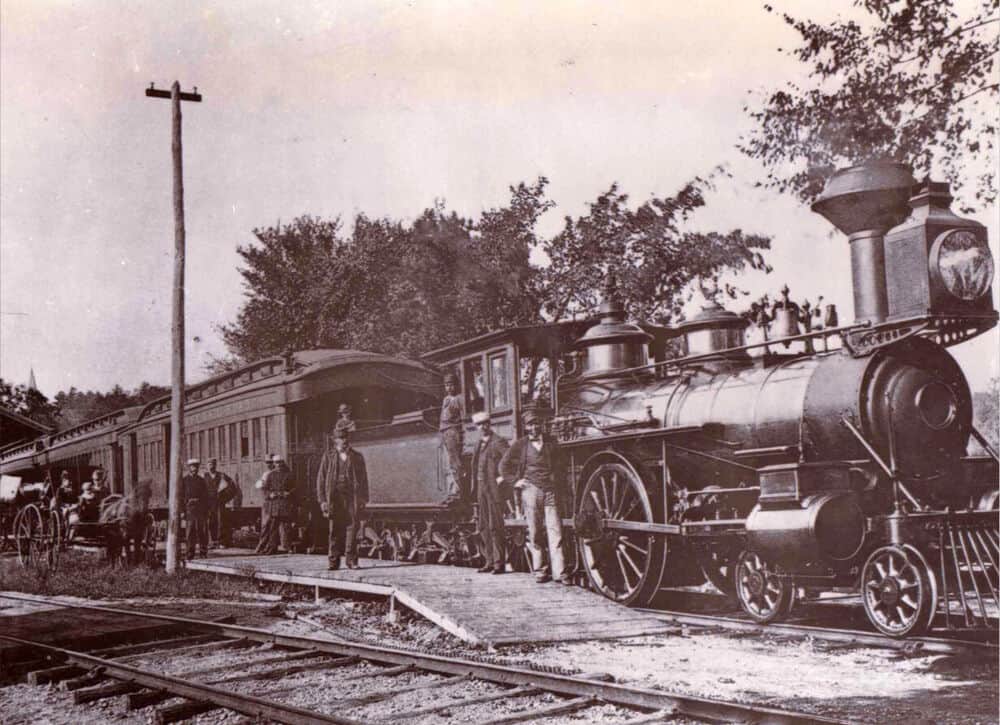
The Cuyahoga Valley Line begins train service from Cleveland to Canton, establishing a vital transportation link through the heart of Northeast Ohio. Operated by the Valley Railway Company, this rail corridor followed the path of the former Ohio & Erie Canal, connecting industrial centers, rural communities, and growing towns along the Cuyahoga Valley. The line supported both passenger and freight service, transporting coal, agricultural goods, and manufactured products while also providing reliable travel for residents and workers. This new rail service significantly boosted regional economic growth by improving access to markets and resources, especially for the steel and manufacturing industries in Cleveland and Akron. Just as importantly, it introduced travelers to the scenic landscapes of the valley, offering views of forests, rivers, and canal-era settlements. The establishment of service in 1880 laid the foundation for continued rail operations along this historic route, preserving a corridor that would eventually evolve from an industrial railway into a scenic and educational passenger experience still celebrated today.

1900

The early 20th century marked the golden age of rail travel in America. Elegant passenger trains offered dining cars, sleeping cars, and scenic journeys. Railroads connected major cities and small towns alike, making travel more accessible than ever. During this era, trains were not only transportation, they were an experience. Rail companies invested heavily in comfort, hospitality, and design, creating beautifully appointed cars with plush seating, fine dining, and attentive onboard service. Travelers could relax, socialize, and enjoy panoramic views of the countryside as they journeyed across the nation. For many Americans, the train station became the gateway to adventure, business opportunities, and family connections. This period also established traditions of onboard storytelling, scenic observation, and guest service that continue to influence heritage and scenic railroads today, where the journey itself remains just as meaningful as the destination.

1972

Cuyahoga Valley Preservation & Scenic Railway Association (dba Cuyahoga Valley Line) is incorporated as a not-for-profit organization.

1975

Started operations as Cuyahoga Valley Line (powered by a steam engine).

1987

Cuyahoga Valley National Park purchases the train tracks from Chessie System.

1988

Cuyahoga Valley Line acquired first diesel locomotive.

1989

Cuyahoga Valley National Park and Cuyahoga Valley Line enter a cooperative agreement, formalizing the partnership for an excursion passenger train ride service through the park.

1994

Cuyahoga Valley Line announces that it has a new name, Cuyahoga Valley Scenic Railroad (CVSR).

2018

Cuyahoga Valley Scenic Railroad (CVSR) acquires four original California Zephyr train cars.

2022

50th anniversary of Cuyahoga Valley Scenic Railroad (CVSR)

Cart
Right Arrow